


 Türkçe
There are many different methods used in industrial production processes, but some of these methods offer particularly high precision and efficiency. Press brake bending, is a widely used forming technique in the metal processing industry. This method, which is especially preferred for bending and shaping thin metal sheets, provides robust and aesthetic results. So, what is press brake bending, how does it work and what advantages does it offer? Here are the answers to these questions and what you need to know about press brake bending.
What is Press Brake Bending?
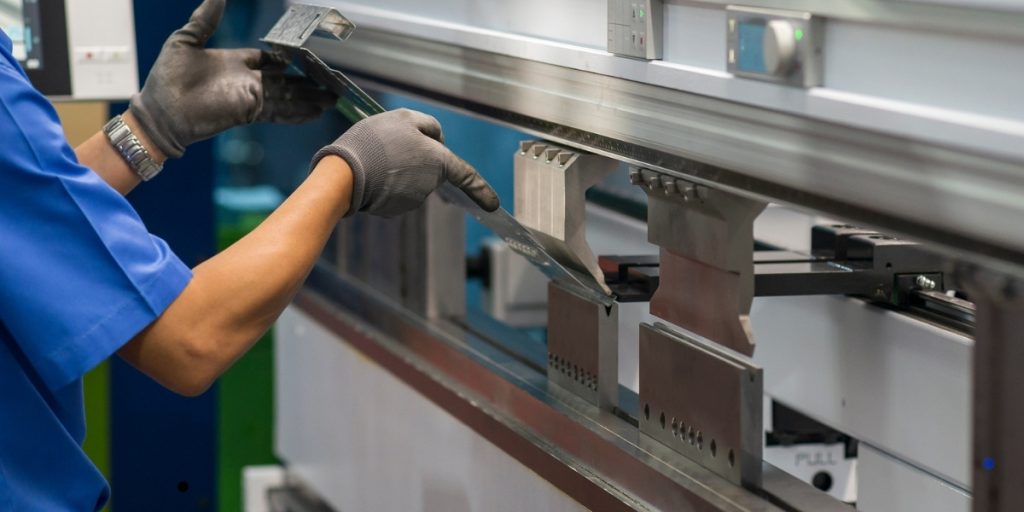
Press brake bending is a forming method that allows metal sheets to be bent at a certain angle. This process is usually done with machines called press brake machines. The sheet metal is placed on the mold at the bottom of the press brake and a tool (piston) at the top bends the sheet metal at an angle. Bending allows the shape of the metal to be changed and this process is commonly used in the metal industry, particularly in the construction, automotive and furniture sectors.
Press brake bending is often used in sheet metal working processes. In this way, metal parts of different shapes can be produced, for example frames, boxes, panels and parts of machines.
Working Principle of Press Brake Bending
The press brake bending process is based on a very simple principle:
- Placing the Metal Sheet:
First, the sheet metal to be bent is neatly placed in the die area of the press brake machine. - Movement between Mold and Piston:
The piston at the top falls on the metal sheet and is transmitted with a certain force to the point to be bent. The mold is the surface that allows the metal sheet to bend and this mold allows the bend to be shaped according to the desired angle. - Twisting and Conclusion:
The applied force allows the metal to bend to the desired angle due to its elastic properties. The most important factor to be considered during this process is the correct selection of the force and mold required for the correct bending.
Advantages of Press Brake Bending
1. High Sensitivity:
Press brake bending is a highly precise forming method. It allows the metal to be bent at a right angle and smoothly. This is a great advantage, especially when producing detailed and complex parts.
2. Usability in Different Metal Materials:
Press brake bending can be applied on various types of metal. Steel, aluminum, stainless steel and many other different metal sheets can be easily shaped with press brake bending. This versatility makes press brake bending a preferred method in many industries.
3. Flexibility and Fast Production:
Press brake bending allows parts of different shapes and sizes to be produced. It also provides a fast production process. It offers a great advantage especially in prototype production and short-term production requirements.
4. Low Cost:
Compared to other metalworking methods, press brake bending is generally more cost-effective. This is because the bending process can be done without the need for complex tooling and equipment. Also, material loss is minimized, which reduces production costs.
5. Reduced Labor:
Press brake bending is usually done with automatic machines. This reduces the need for manpower in the production process and prevents errors. It also increases productivity by increasing production speed.
Where is Press Brake Bending Used?
Press brake bending is widely used in various industries. This method is particularly important in many sectors that require metal forming. Here are some areas where press brake bending is used:
- Automotive Sector:
In the automotive industry, press brake bending is often used in the production of automobile parts. Especially frame and chassis parts can be shaped by press brake bending. - Construction and Building Sector:
Press brake bending is quite common in the construction industry, especially for steel structures and prefabricated metal structures. Metal panels and columns can be shaped with press brake bending. - Electronics and White Goods Production:
Press brake bending techniques are also used in the production of enclosures used in the electronics industry and white goods. In these sectors, metal boxes and enclosures are produced with press brake bending. - Furniture and Interior Design:
The production of metal furniture parts for modern designs can be easily realized with press brake bending. It is used especially for metal shelves, table legs and decorative panels.
Tips on Press Brake Bending
- Mold Selection:
The accuracy of the bending process depends on the shape and size of the mold used. A well-chosen mold ensures that the bending is smooth and error-free. - Material Thickness:
The thickness of the metal is an important factor for the bending process. Thicker sheets require more force, while thinner sheets bend more easily. - Bend Angles:
The correct calculation of the bending angles is important to achieve the desired result. Otherwise, the bending of the metal may be uneven or the material may be damaged.
Conclusion Strong and Aesthetic Metal Parts with Press Brake Bending
Press brake bending has a very important place among metal forming technology. Thanks to its advantages such as high precision, fast production and low cost, it is a preferred method in many sectors. The ability to apply to different types of materials and offer flexible production options makes press brake bending an indispensable production tool. If you need metal processing and shaping, you can obtain quality and aesthetic parts with press brake bending.
